Cross-Account Coverage
Deploy once and monitor many AWS accounts from a single threat timeline. Cross-account coverage is available on the advanced tier and above — up to 200 sources on advanced, unlimited on enterprise.
AI SIEM works the same whether those accounts belong to an AWS Organization or are separate, standalone accounts: authorize an entire organization in one step, or add individual account IDs explicitly. Either way, every event keeps its originating account ID, so threats, timelines, and behavioral baselines stay attributed to the account they came from.
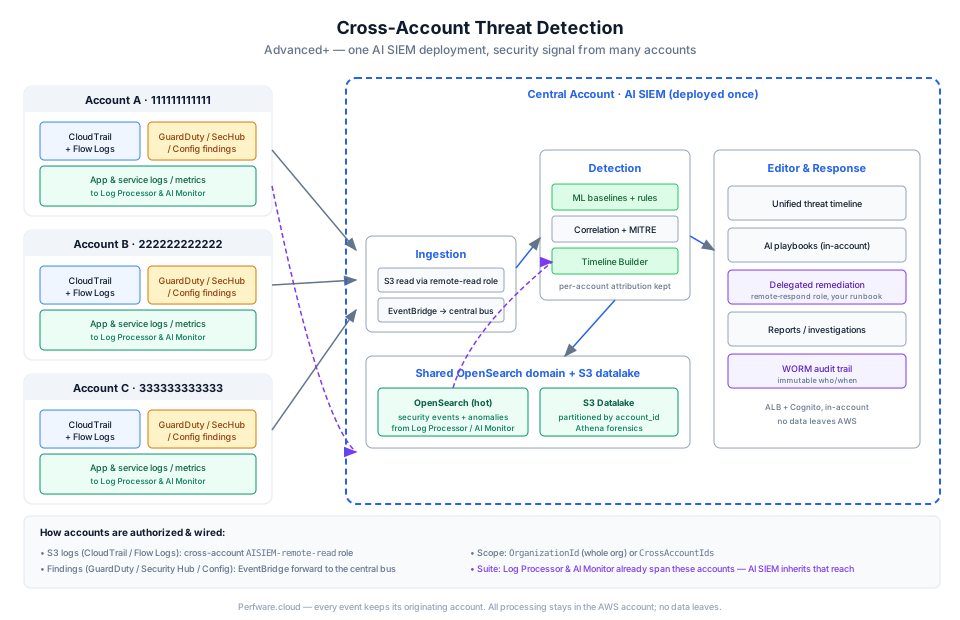
How remote accounts are read
AI SIEM pulls signals from remote accounts two ways, depending on the source:
- CloudTrail and VPC Flow Logs — read directly from each remote account over a cross-account IAM role that you create and own. AI SIEM assumes the role to read; it holds no standing access beyond what the role grants.
- GuardDuty, Security Hub, and Config — findings are forwarded to AI SIEM's event bus (via EventBridge) from each source account, so they land on the same timeline as the CloudTrail and Flow Log activity.
Setup
Authorize remote accounts at deployment:
- Add individual account IDs to onboard specific accounts, and/or
- Authorize an entire AWS Organization so any member account can be onboarded without listing IDs individually.
For CloudTrail and Flow Log sources, create the cross-account IAM role in each remote account that AI SIEM assumes to read. For GuardDuty, Security Hub, and Config, forward findings from each source account to the AI SIEM event bus.
The helpers that do this —
setup-remote-accessandadd-accountfor the read roles,wire-eventsfor finding forwarding — ship in the helper-scripts bundle (.cmdfor Windows,.shfor Linux/macOS). Download it from Guides & Downloads and see getting started for the step-by-step.
Attribution across the timeline
Because every ingested event retains its source account ID, a threat actor moving between accounts is tracked as one correlated narrative rather than fragmented per-account views. Timelines, severity, and ML behavioral baselines are computed per principal with the originating account preserved, so cross-account activity reads as a single kill chain.