AI Features
AI Monitor's AI features — metric discovery suggestions, anomaly explanations, and tuning recommendations — run on Amazon Bedrock (Anthropic Claude) inside your own AWS account and Region, called by the stack's own Lambda role. Nothing is sent to Perfware or the model provider, and per AWS's Bedrock terms your prompts are never used to train the models. Resource identifiers are kept out of the prompts — never specific values, account IDs, or Regions. AI features are optional and available on the advanced and enterprise tiers.
AI recommendations are guidance only. They may be inaccurate, incomplete, or inappropriate for your environment — always review and validate before applying. Costs are negligible, around $0.001–0.002 per call.
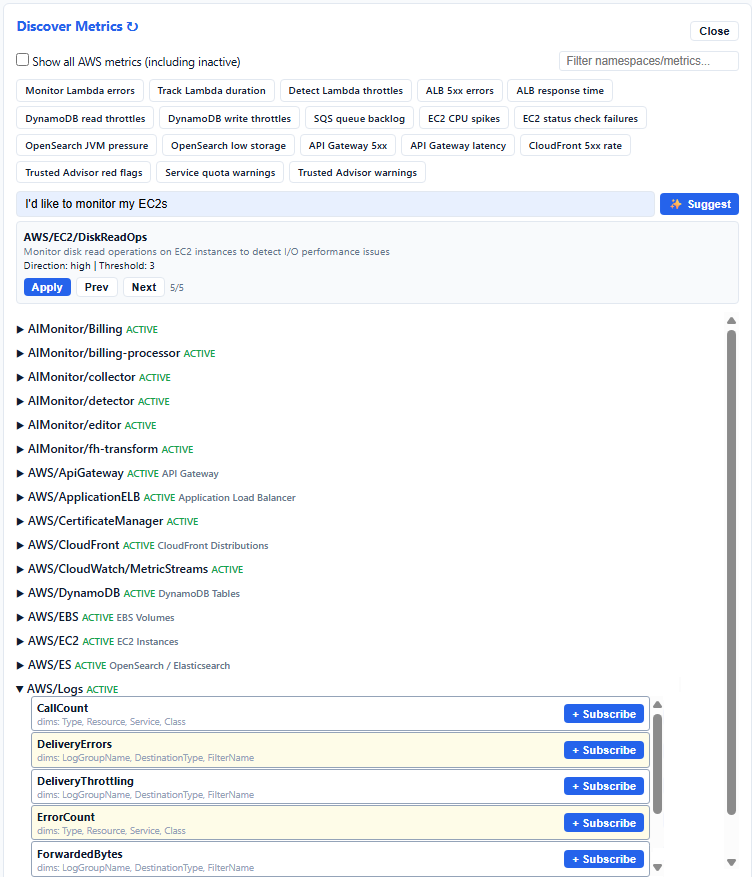
Discovery and natural-language suggestions
The discovery wizard scans your account for all available CloudWatch metrics so you can browse namespaces, see what's active, and click to subscribe. On advanced and enterprise tiers, a natural language prompt lets you type something like "monitor my Lambda errors" or "alert me if S3 costs spike," and Bedrock returns a fully configured subscription suggestion based on your available metrics. For ambiguous requests, use Prev/Next to navigate additional suggestions and apply the ones you want.
In all tiers you can browse metrics manually or use clickable chips that pre-fill the form with built-in smart mappings — no AI call needed.
Anomaly explanations
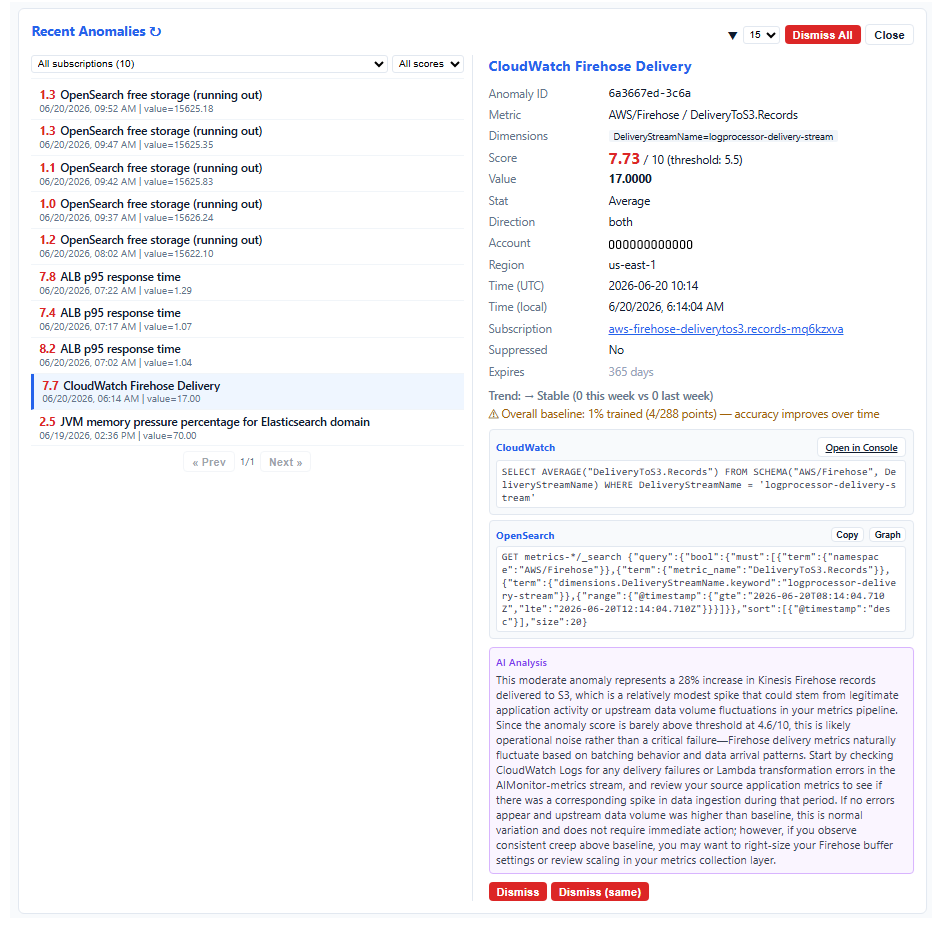
On advanced and enterprise tiers, each anomaly alert includes an AI-generated analysis section. Bedrock receives the anomaly context — metric name, current value, baseline mean, score, and any correlated metrics — and produces a 2–3 sentence explanation: likely cause, what to investigate first, and whether it's probably a real issue or noise. It's labeled "AI Analysis (experimental)" in the email.
Assisted tuning
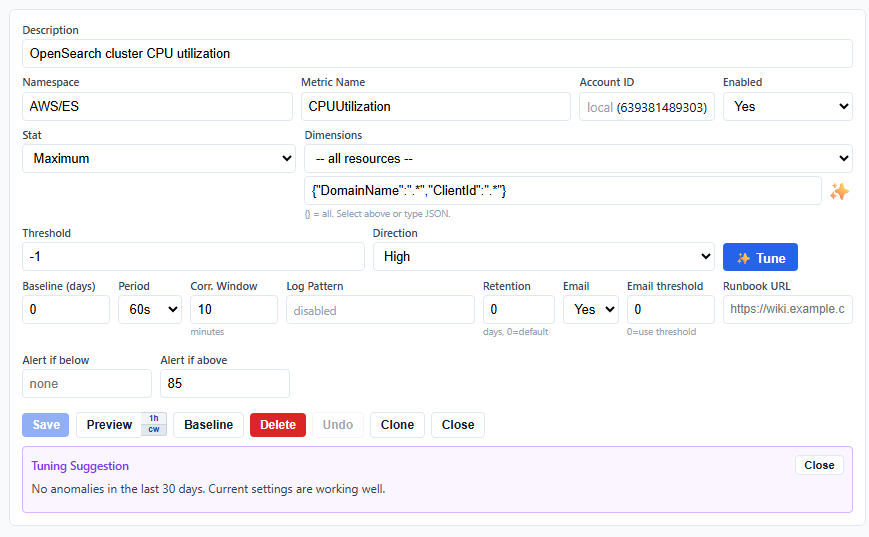
In Recent Anomalies, open a subscription's detail and click "Tune." Bedrock leverages recurring anomaly history and suggests changes you can apply with one click (~$0.0003 per tune).
Tuning uses a rules-based engine for the numbers and Bedrock only for the explanation. Language models are good at explaining but unreliable at picking numeric thresholds, so the engine computes thresholds from your actual anomaly frequency, metric type, and observed percentiles — then Bedrock writes the human-readable rationale. The result is consistent, repeatable recommendations grounded in your data.
Enabling AI features
AI features require Amazon Bedrock access to Anthropic Claude models. Use the provided check-quota script to verify access and sufficient resources, and submit requests as recommended.